
Florida Keys Fixer-Upper and the 50% Flood Rule
Before you write an offer, find out whether your planned scope could reach half of the structure's market value. In a Special Flood Hazard Area, crossing that line can require elevation and other current-code work, so the renovation budget you started with may not be the one you end up with.
Florida Keys Fixer-Upper and the 50% Flood Rule
What is the 50% flood-improvement rule for a Florida Keys fixer-upper?
A Florida Keys fixer-upper in a Special Flood Hazard Area can trigger current flood-construction standards once the cost of improvements equals or exceeds 50% of the structure's market value before work begins. Monroe County calls this the "50% rule." When a project reaches it, the plans must show how the structure will comply with current floodplain requirements, which can include raising the lowest floor to or above base flood elevation. Check the numbers before you buy, not after.
Key Takeaways
- Recent local market data puts the median sale price at $1,059,500 for homes sold in the Florida Keys over roughly the last 90 days (through October 2026), so even a discounted fixer-upper is a major commitment that a flood rule can reshape.
- In Monroe County, a substantial improvement is any reconstruction, rehabilitation, addition, or other improvement costing 50% or more of the structure's market value before the work starts.
- The valuation that matters is the structure's pre-improvement market value, not automatically your purchase price or the combined land-and-building value.
- Reaching the threshold is not a renovation allowance: it can require current-code compliance, including elevation, flood vents, and raised HVAC and utilities.
- The rule also applies after fire, flood, or other damage, not only after a planned remodel.
What counts toward the 50% threshold in Monroe County?
Any reconstruction, rehabilitation, addition, or other improvement whose cost equals or exceeds 50% of the structure's market value before the improvement begins counts as a substantial improvement, according to Monroe County's substantial improvement packet. The rule applies to structures in regulated flood-hazard areas.
Here's a simple illustration, not a prediction for any property. If a structure's market value before work were $200,000, the threshold would be $100,000 of improvements. Your project doesn't need to be a gut job to get there, and that's what catches buyers off guard.
Is it based on what I pay for the home?
Not automatically. The relevant figure is the structure's pre-improvement market value, which is different from your purchase price and from the combined value of land and building. In the Keys, land can carry a large share of what a buyer pays, so the structure's value may be a smaller number than you'd expect. The county's application materials control the documentation and valuation method for your specific project.
Does a roof or kitchen renovation count?
I won't guess line by line, because the county's process uses an itemized project-value worksheet, bids, and the construction contract to total the work. What I can tell you is to define the complete scope up front: structural, mechanical, electrical, plumbing, HVAC, and any damage-related repairs. The county's Building and Permitting page also notes that projects may not be divided to avoid permitting requirements. Phasing the work to stay under the line is not a strategy.
Does it apply after hurricane or flood damage?
Yes. A structure can be affected after fire, deterioration, flood, or other damage, not just a planned remodel. Substantial damage is measured separately: it generally applies when the cost to restore the structure to its pre-damage condition equals or exceeds 50% of its pre-damage market value. A structure found substantially damaged is treated as substantially improved, regardless of the repair work ultimately performed. If you're eyeing a storm-damaged Florida Keys fixer-upper, this is the first question to ask.
What happens if my fixer-upper sits below base flood elevation?
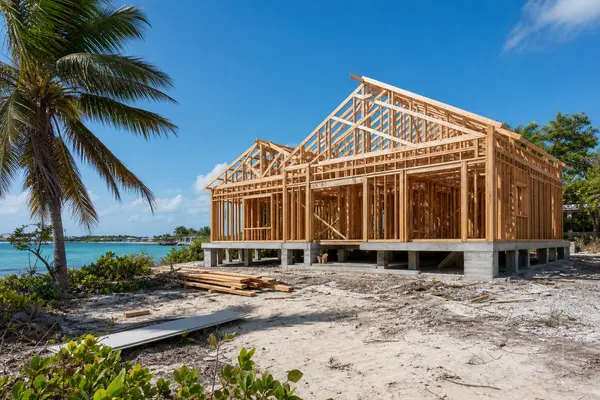
Once the project reaches the threshold, the plans must show how the structure will be brought into compliance with current floodplain requirements. For a residential structure in a Special Flood Hazard Area, that can mean elevating the lowest floor to or above the applicable base flood elevation. The exact requirement depends on the flood zone, site-specific elevation data, and the applicable Monroe County and Florida Building Code provisions.
What does flood-compliance work include?
The county lists several forms of flood-proofing and compliance work, depending on the property and the requirements that apply:
- Structure elevation
- Flood vents
- Elevation of HVAC equipment and utilities
- Abandonment or fill
- Demolition
The county's substantial improvement FAQ adds elevation-related requirements for electrical and mechanical equipment, air-conditioning equipment, bathrooms, and laundry rooms on a noncompliant structure. That's why a plan that started as "new kitchen and paint" can turn into a very different project.
Can I renovate without elevating the whole structure?
Possibly, if your project stays below the threshold and the work is permitted properly. But don't build a plan around hugging the line. The county's permitting page says work in a flood-hazard area is not eligible for the exemption pathway it cites, and exempt work can't include electrical, plumbing, structural, mechanical, or gas work. Your contractor and the county's Building Department need to confirm the path for your property.
Why does the rule matter more on a lower-priced Florida Keys property?
Because the threshold is a percentage of the structure's value, a lower-valued structure reaches it with fewer renovation dollars. A discount that looked like a bargain can shrink or vanish if the work triggers elevation and utility upgrades.
For context, recent local market data shows a median sale price of $1,059,500 across 464 homes sold in the Florida Keys over roughly the last 90 days through October 2026. There are 1,219 homes for sale now, with 268 new listings in the last 30 days. Those are area-level figures. Any individual home's value depends on condition, street, build year, and timing, and the structure's value is a separate number from the sale price.
| Area | Median Sale Price |
|---|---|
| Key West | $1,046,250 |
| Big Coppitt | $779,000 |
| Cudjoe Key | $920,000 |
| Summerland Key | $1,000,000 |
| Big Pine Key | $846,500 |
Those medians tell you what the market looks like, not what the structure on any one lot is worth. Fold the flood zone and insurance into your numbers before you fall for a property. My breakdown of how flood zones affect the cost of owning in Key West and my overview of flood zones and Florida Keys waterfront homes are good places to start.
Your specific number depends on the structure, the zone, and the scope. That's where a local market analysis and a conversation with the county come in.
What should I check before I make an offer on a flood-zone fixer-upper?
Work through the flood zone, the elevation data, and the full project scope before you finalize a renovation plan. Here's the sequence:
- Identify the flood zone and applicable base flood elevation using the property's FEMA flood information and Monroe County's current floodplain requirements.
- Obtain or order a current Elevation Certificate. The county uses it to help determine the structure's elevation and whether it complies. Without a current one, the county may require additional review or site verification, per its application packet.
- Define the complete intended scope, including structural, mechanical, electrical, plumbing, HVAC, and any damage-related work.
- Get the project cost documented through itemized bids and contracts.
- Ask Monroe County's Building Department whether the proposed work requires substantial-improvement review.
- Confirm what elevation, floodproofing, utility, access, and other current-code measures would be required if the project reaches the threshold.
The county's process calls for a current Elevation Certificate, a substantial-improvement or substantial-damage application, owner and contractor affidavits, an itemized project-value worksheet, project bids, and the construction contract, per the county FAQ. Ask your real estate attorney to make sure your contract gives you enough time to finish this homework before you're committed.
This is exactly the kind of question I walk my clients through before they write an offer. If you're weighing a fixer-upper in Key West, Big Pine Key, Cudjoe Key, or anywhere else in the Keys, the right first step is a hard look at the structure, the zone, and the scope. If you're comparing it with an investment plan, my post on Florida Keys investment property rules to check first covers the other rules to run down.
Elevation requirements also sit alongside construction standards. My piece on hurricane building codes for Florida Keys homes covers that side.
Want to hear from people I've worked with? You can read Jimmy's reviews on Google and Zillow.
FAQ
Is the 50% calculation based on my purchase price?
No, not automatically. The test compares the cost of the improvements to the structure's market value before the work begins. That is different from your purchase price or the total land-and-building value. The county's application materials control the documentation and valuation method for your project.
Do I need an Elevation Certificate before buying a Florida Keys property?
It's one of the most useful documents to have early. Monroe County's substantial-improvement process calls for a current Elevation Certificate to help determine the structure's elevation and whether it complies with current floodplain rules. If you're buying a fixer-upper, get one in hand or ordered before you lock in a renovation scope.
Does the 50% rule apply to repairs after hurricane or flood damage?
Yes. Monroe County states that structures considered substantially damaged or substantially improved must be elevated above the applicable flood level when repaired. Substantial damage is generally measured by whether the cost to restore the structure to its pre-damage condition equals or exceeds 50% of its pre-damage market value.
Who determines whether my planned work reaches the threshold?
Monroe County reviews it through its substantial-improvement application process, using your documentation, such as bids, the project-value worksheet, and the Elevation Certificate. Ask the county's Building Department before you commit to a scope, and have your contractor's itemized numbers ready.
The core takeaway: the 50% rule can turn a low-priced Florida Keys fixer-upper into a very different project, so run the structure's value, the flood zone, and your full scope past the county before you're locked in. I help buyers do that homework as part of every property search. Schedule a complimentary consultation and we'll go through the property, the zone, and the numbers together.
Equal Housing Opportunity. Jimmy Lane, Principal Broker, Island Life Realty Experts, regulated by the Florida Real Estate Commission. This article is general information, not legal, tax, or financial advice. Confirm your own numbers and requirements with your real estate attorney, tax advisor, lender, and Monroe County's Building Department.
Categories
- All Blogs (54)
- flood insurance (1)
- Buyer Guides (1)
- Buying (2)
- Buying a Home (4)
- Florida Keys Real Estate (9)
- Investment Properties (2)
- Relocation (1)
- Selling a Home (1)
- Buyer Guides (1)
- Buyer Resources (1)
- Buyers Guide (1)
- Buying (3)
- Buying a Home in Key West (2)
- Buying in Key West (2)
- Buying in the Keys (1)
- Closing Costs (2)
- Costs & Financing (1)
- Cudjoe Key (2)
- flood insurance (1)
- Florida Keys fixer-upper (1)
- Florida Keys flood zones (2)
- Florida Keys Living (1)
- Florida Keys Market (7)
- Florida Keys Real Estate (4)
- Florida Keys Real Estate Costs (1)
- Florida Keys Real Estate Guide (1)
- Florida Keys Real Estate Tips (1)
- Hurricane Preparedness (1)
- Insurance (2)
- Insurance & Costs (2)
- Insurance & Flood Zones (1)
- Insurance & Risk (1)
- Investing (2)
- Investment Properties (2)
- Investment Real Estate (1)
- Investors (1)
- Key West (2)
- Key West buyers (1)
- Key West Market (1)
- Key West Real Estate (4)
- Luxury Real Estate (3)
- market insights (3)
- Market Trends (1)
- NFIP (1)
- Seller Resources (1)
- Selling (5)
- Selling / Seller Resources (2)
- Selling a Home in Key West (1)
- Selling in Key West (1)
- stock island (1)
- Tax & Legal (1)
- Tips for Buyers (1)
- Vacation Rental (1)
- vacation rental investment (1)
- Waterfront (1)
Recent Posts
GET MORE INFORMATION